
Table of Contents
- Why Brand Colour Consistency Matters on Promotional Pens
- Understanding Your Brand Colour Palette
- Custom Colour Promotional Pens: Matching Pen Barrel and Components to Your Brand
- Logo Printing on Pens: Methods and Colour Reproduction
- Full-Colour Printed Pens: Design Specifications and Quality Standards
- Branded Pens With Logo: A Step-by-Step Ordering and Approval Checklist
- Pen Styles, Materials, and Colour Durability
- Frequently Asked Questions
Last Updated: October 19, 2026
Why Brand Colour Consistency Matters on Promotional Pens
Brand colour consistency is the foundation of how people recognize and remember your business, and customizing pens with corporate brand colors makes this consistency tangible in daily use.
Colour matching sounds simple but requires precision. A pen that’s “close enough” to your brand blue actually signals carelessness, and your audience notices the mismatch even if they can’t articulate why the pen feels off-brand.
At Jott Europe Ltd, we’ve worked with hundreds of companies customizing pens with corporate brand colours, and the ones that see the strongest engagement are those that treat colour matching as a technical specification, not an afterthought.
Understanding Your Brand Colour Palette
Your brand colour palette is the controlled set of colours that represent your business across all touchpoints, including promotional merchandise. Most brands operate with a primary colour, one or two secondary colours, and accent colours for highlights and calls to action.
Identifying your primary, secondary, and accent colours
Your primary colour dominates your visual identity and carries the strongest emotional association with your brand. Secondary colours support it without overwhelming it, while accent colours are used sparingly for emphasis.
Audit your existing brand materials, noting which colours appear most often and in what proportions, as this groundwork is essential before customizing pens with corporate brand colors. If you have a brand guideline document, it should already specify these; if not, create this breakdown before customizing pens with corporate brand colours.
Documenting colour codes for consistency
Colours exist in multiple formats: RGB for digital displays, CMYK for print, and Pantone numbers as industry-standard references that ensure consistency across suppliers and materials.
Document all three formats for your primary and secondary colours; your graphic designer or brand team can extract them from existing brand files. When you order promotional pens, these numbers are your specification sheet.
RGB example: 25, 118, 210 (a professional blue)
CMYK example: 88, 55, 0, 18 (the print equivalent)
Pantone example: PMS 279 C (the industry standard reference)
Custom Colour Promotional Pens: Matching Pen Barrel and Components to Your Brand
Customizing pens with corporate brand colours means making decisions about which parts of the pen carry your colours. The barrel is the main body. The grip is where your hand holds it. The trim is the metal or plastic accent piece, often at the clip or tip. Each component offers a colour choice, and together they create your pen’s visual identity.
Selecting barrel colour options
The barrel is your primary real estate for branding. Your goal is to find the closest match to your primary brand colour.
Many organizations make their first mistake here: they choose a barrel colour that’s “close” and hope it works. Instead, order a physical sample and view it in your office lighting next to your brand colour swatch, since colour perception changes dramatically with lighting and context.
If your brand colour isn’t available as a standard barrel option, ask your supplier about custom colour runs.
Choosing complementary grip and trim colours
Grip and trim colours should complement your barrel without competing for attention. Match the grip to your barrel with a contrasting or neutral trim, or use your secondary brand colour for the grip to add visual interest within your palette.
Chrome or silver trims work with nearly any barrel colour, black trims add sophistication, and coloured trims like gold or rose gold can elevate perceived quality. The choice depends on your brand aesthetic and budget.
Logo Printing on Pens: Methods and Colour Reproduction
Once you’ve selected your pen colours, the next decision is how to apply your logo. The printing method you choose directly affects colour accuracy, durability, and cost. There are several methods, each with trade-offs.
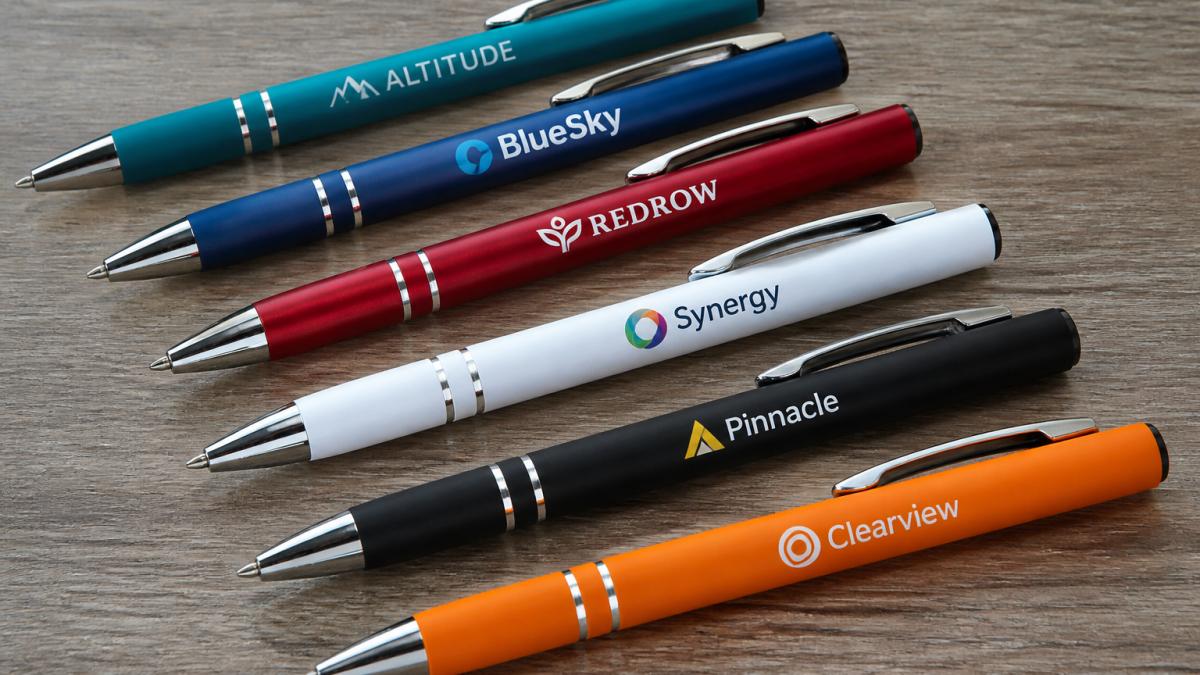
Print method options and colour accuracy
Pad printing uses a silicone pad to transfer ink from an engraved plate onto the barrel.
Screen printing pushes ink through a mesh screen, producing vibrant colours and handling bold designs well, but it uses standard ink colours rather than custom matching.
Digital printing offers full-colour reproduction of photographs, gradients, and multi-colour designs directly onto the barrel. It’s a flexible option for complex designs, but works with standard CMYK inks that may not match your brand colour precisely.
UV printing cures ink instantly with UV light, producing sharp, vibrant results on various pen materials. It offers good colour accuracy and durability.
Colour reproduction limitations and how to work within them
You choose the closest match to your exact Pantone 279 C.
This is why physical proofs are essential. Request a sample pen printed with your supplier’s closest recommended colour, hold it next to your brand swatch, and if it’s noticeably off, explore a different printing method or adjust your logo design to work with the available colours.
Some suppliers offer Pantone matching for larger orders. If you’re ordering a large volume, it’s worth asking whether they can mix a custom ink to match your exact Pantone number. This ensures perfect colour consistency across your entire order.
Full-Colour Printed Pens: Design Specifications and Quality Standards
Full-colour printing on pens is possible with digital or UV methods, but it requires attention to file format, resolution, and design considerations specific to the curved surface of a pen barrel.
Resolution and file format requirements
Your logo file must be high-resolution, typically 300 DPI minimum, or it will print blurry on the barrel. Suppliers usually accept PDF, EPS, or high-resolution TIFF or PNG files.
The barrel is a curved surface, not flat paper. Ask your supplier for a template showing the exact printable area dimensions, and design your logo to fit: oversized designs get cropped and undersized ones look lost.
Provide your file in CMYK colour mode, not RGB. CMYK is the print standard and ensures the colours you see on screen translate accurately to the printed pen.
Ensuring legibility and contrast on small surfaces
A pen barrel is small, so your logo must be legible at that scale. Fine details, thin lines, and small text can disappear during printing, so test your design at actual size on a pen-sized mockup.
Contrast is critical: dark logos on dark pens are hard to see, and light logos on light pens disappear. Add a thin dark outline or shadow to white logos on light barrels, and use sans-serif fonts for text since they’re clearer at small sizes.
Avoid gradients and subtle colour transitions. They don’t reproduce well on pens. Solid colours and bold designs print sharper and more professional.
Branded Pens With Logo: A Step-by-Step Ordering and Approval Checklist
Ordering customized pens involves multiple steps and decision points. A structured checklist prevents costly mistakes and missed deadlines.
Preparing your design files and colour specifications
Before you contact a supplier, gather:
- Your logo file in high-resolution format (300 DPI minimum, CMYK colour mode)
- Your brand colour codes (RGB, CMYK, and Pantone)
- A specification document listing: pen model, barrel colour, grip colour, trim colour, printing method, logo placement, and any text or slogans
- Your minimum order quantity, target delivery date, and budget range
Provide these details in writing; vague requests lead to mismatched expectations, while specificity yields accurate quotes and timelines.
Reviewing proofs and approving colour accuracy
Once the supplier prepares your order, request a physical proof, an actual pen with your logo printed on it. Do not skip this step. Digital mockups don’t show you how the pen looks and feels in reality.
When the proof arrives:
- Compare the barrel colour to your brand colour swatch under multiple lighting conditions (office, natural light, dim light)
- Check that the logo is sharp, legible, and positioned correctly
- Verify that the grip and trim colours match your specification
- Test the pen’s writing quality, it should write smoothly
- Inspect the overall finish and feel, does it feel premium?
If the proof meets your standards, approve it in writing and confirm the production timeline. If something is off, the colour is noticeably different, the logo isn’t positioned correctly, or the print quality is poor, communicate the issue clearly and request a revised proof.
Managing timelines and minimum order quantities
Most suppliers have minimum order quantities (MOQs). Confirm the MOQ upfront so you’re not surprised by a price that assumes a larger order than you intended.
If you have a specific deadline, communicate it early and confirm the supplier can meet it.
Build in buffer time and order earlier than you think you need to. Shipping delays happen, and pens arriving after your event mean the entire investment is wasted.
Pen Styles, Materials, and Colour Durability
The material your pen is made from affects how colours look, how they age, and how premium the pen feels in hand.
Plastic, metal, and wood pens: colour options and finishes
Plastic pens have a wide range of barrel colours. They feel lightweight, but modern plastic pens with rubberised grips and quality finishes feel professional and substantial, and the colour won’t fade or chip easily.
Metal pens feel heavier and more premium, conveying quality to recipients. Metal barrels come in fewer colours, often silver, black, gold, or rose gold, but coloured grips add flexibility without sacrificing the premium feel.
Wood pens are distinctive, natural, and warm, appealing to environmentally conscious recipients. Colour options are limited to natural tones or painted finishes, but they stand out from standard plastic and metal pens.
How material choice affects colour vibrancy and longevity
Plastic pens hold colour vibrantly for years because the colour is integral to the plastic, not a coating.
Metal pens with painted or anodised finishes are durable, but the finish can scratch or wear with heavy use. Some recipients appreciate this patina; others prefer the pristine look of plastic.
Wood pens are susceptible to moisture and temperature changes, warping or cracking under extreme conditions.
For maximum colour durability, choose plastic; for premium perception, metal with a quality finish; for differentiation and environmental appeal, wood, understanding that durability depends on how the recipient treats it.
Customizing pens with corporate brand colours transforms a simple promotional item into a branded asset that reinforces your visual identity. Our iconic Contour pen and diverse colour options give you the flexibility to create pens that feel authentically yours.
Frequently Asked Questions
How do you match promotional pens to corporate brand colours?
Start by documenting your brand’s official colour codes in RGB, CMYK, and Pantone formats. When customizing pens with corporate brand colors, request colour swatches from your supplier to compare against your specifications. Most suppliers provide physical samples so you can verify the match under different lighting before placing your full order. Discuss any colour reproduction limitations with your supplier, as some printing methods may not achieve exact matches on all pen materials.
What printing method produces the best colour accuracy for full-colour printed pens?
Full-colour printed pens typically use UV printing or pad printing, depending on the design complexity. UV printing handles intricate multi-colour logos with high precision. Pad printing suits simpler designs and offers good durability. Ask your supplier which method they recommend for your specific logo and pen material, and request a proof sample to verify colour accuracy before committing to your full order.
Can you print a logo on a pen clip as well as the barrel?
Yes, many suppliers offer logo printing on both the barrel and clip. However, clip printing has space constraints and may limit colour options or detail. Some clips are metallic or translucent, which affects how colours appear. Discuss placement options with your supplier during the design phase. Confirm these details early if you need both areas branded.
What should I check when reviewing proofs for branded pens with logo?
When reviewing proofs, verify colour accuracy against your official brand codes under natural and artificial lighting. Check that your logo is legible at actual size, with sufficient contrast between the logo and pen barrel. Confirm text readability, particularly for smaller fonts. Look for any printing defects, uneven coverage, or misalignment. Request revised proofs if colours don’t match your specifications or if legibility is compromised. Approve proofs in writing before production begins to avoid costly reprints.