
Last Updated: November 4, 2026
Quick Summary
Custom pens are a practical marketing tool for small businesses because people keep and use them. Research from the Advertising Specialty Institute estimates a branded pen generates roughly 2,436 impressions over its lifetime. Choose materials, finishes and print methods to match how the pen will be used.
- A branded pen generates roughly 2,436 impressions over its lifetime, per ASI 2023 research.
- Plastic barrels keep unit costs low, while metal barrels feel heavier and more premium.
- Place the logo on the barrel body for the largest print area and a full logo.
- Ordering just under a price break is often false economy, since the extra pens may cost less overall.
- Ask suppliers for the all-in figure, including set-up, proofing, delivery and VAT, before comparing quotes.
Table of Contents
- Why Custom Pens Still Work for Small Business Marketing
- Choosing the Right Pen: Materials, Styles and Finishes
- Custom Pen Design Ideas That Get Kept and Used
- Promotional Pens for Events, Trade Shows and Conferences
- Branded Pens for Small Businesses: Budgeting and Order Sizes
- Small Business Promotional Products: Where Pens Fit in Your Mix
- Sustainable Options and Design Files for Non-Designers
- Measuring Results and Distributing Your Pens Well
- Requesting a Quote for Your Next Pen Order
- Frequently Asked Questions
Why Custom Pens Still Work for Small Business Marketing
Custom pens remain one of the most practical forms of marketing for small businesses, and Jott Europe Ltd supplies promotional writing instruments across the UK. Research from the Advertising Specialty Institute (ASI) (2023) estimates that a branded pen generates roughly 2,436 impressions over its lifetime, which makes it one of the longest-running touchpoints a small business can buy for a modest sum. ASI 2023 Ad Impressions Study, as reported by Custom Ink
The reason is simple: a pen gets used. It sits on a desk, travels in a bag and gets picked up during calls. For a small business with a tight budget, that repeat exposure matters more than a one-off flyer that gets binned.
The catch is that not every pen earns its place. Half-hearted promotional pens get thrown away, and that does nothing for your brand. The rest of this guide covers how to choose pens that get kept, where to put your logo, and how to order without overspending.
Choosing the Right Pen: Materials, Styles and Finishes
The right pen starts with how it will be used. A pen handed out at a trade show needs to survive a day of being grabbed and dropped. A pen given to a client after a meeting needs to feel like something they would choose themselves.
Materials shape that first impression. Plastic barrels are the most common and keep unit costs low. Metal barrels feel heavier and more premium. Wood finishes suit businesses with a natural or sustainable angle. Jott’s range covers plastic, metal and wood, so you can match the pen to the message.
Finish matters as much as material. Rubberised grips add comfort for long writing sessions. Chrome trims lift the look of a standard barrel. Frosted barrels give a softer, more modern feel and show print well.
Consider the ink too. Gel ink writes more smoothly than standard ballpoint and suits pens that will be used heavily. Check with your supplier that the ink and barrel suit your intended use before you commit to a full run.
The article compares the main pen materials and finishes, which can be summarised at a glance:
| Option | Best for | Key difference |
|---|---|---|
| Plastic barrel | Low unit costs | Most common, keeps costs down |
| Metal barrel | Premium feel | Feels heavier and more premium |
| Wood finish | Natural or sustainable angle | Suits natural or sustainable messaging |
| Rubberised grip | Long writing sessions | Adds comfort |
| Chrome trim | Standard barrels | Lifts the look |
| Frosted barrel | Modern look | Softer feel, shows print well |
Custom Pen Design Ideas That Get Kept and Used
A pen that is kept has usually been designed with the recipient in mind. Smooth, curved lines and an ergonomic shape make a pen pleasant to hold. Generous print areas give you room for a clear logo and a short message without looking cluttered.
Keep the design simple. Two or three brand colours, a clean logo and a single call to action work better than a busy layout.
Design also depends on the decoration method. Screen printing suits one or two colours on larger runs. Full-colour digital print works well for photographic or gradient logos. Laser engraving gives a permanent, premium look on metal barrels. Ask your supplier which method suits your artwork before you finalise the design.
Logo Placement and Print Areas
Place your logo where it will be seen during normal use. The clip side is usually the most visible when the pen is in a pocket or on a desk. The barrel body gives the largest print area and is best for a full logo. Avoid placing key text where the grip will cover it.
Keep text large enough to read at arm’s length. Small type that looks sharp on screen can blur on a curved barrel, so check your proof on a physical sample where you can.
Promotional Pens for Events, Trade Shows and Conferences
Events are where custom pens earn their keep. Visitors collect a lot of material at a trade show, and a pen is one of the few items they will actually use afterwards.
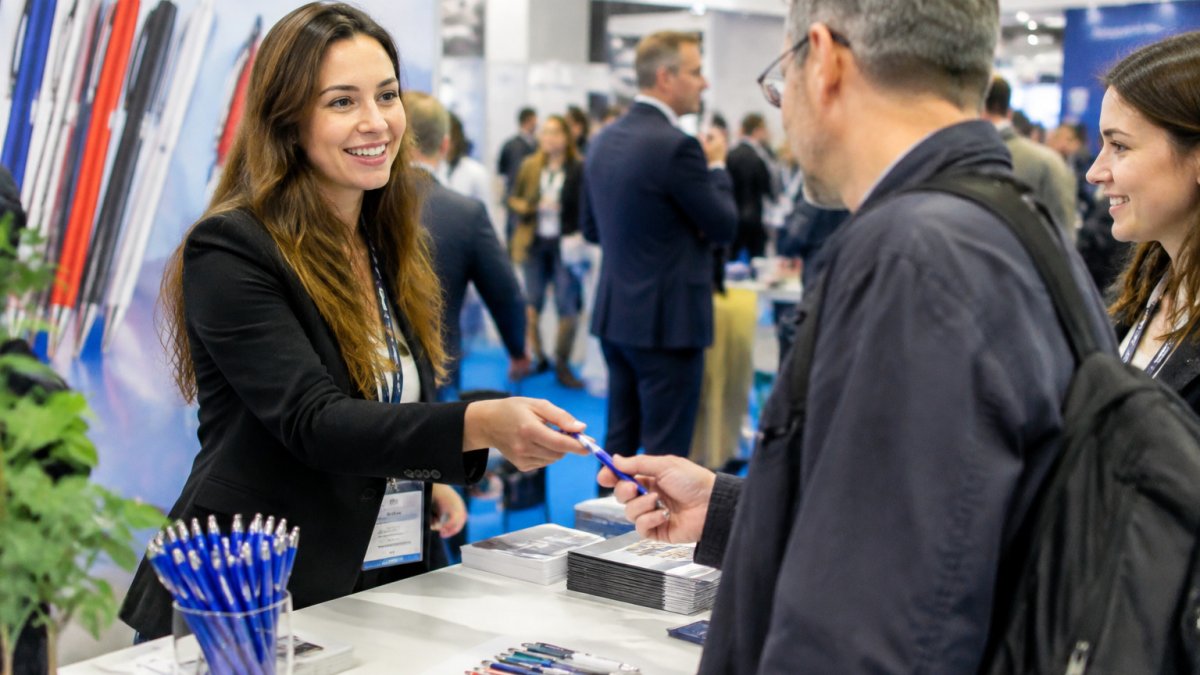
Plan quantities around footfall and the number of conversations you expect to have. Running out on day one is more costly than a small surplus you can use at the next event. The iconic Contour pen is part of the Jott range.
Pens also work well as a follow-up gift. A branded pen sent with a thank-you note after a conference reinforces the conversation you had on the stand.
Branded Pens for Small Businesses: Budgeting and Order Sizes
Pricing depends on quantity, specification, decoration method and delivery date, so the most reliable way to budget is to request a quote for your exact specification. The cost of a pen changes with those factors. What follows is how those factors interact, so you can plan a realistic order.
The single biggest lever is quantity. Most suppliers set up a print run once, then print across the whole batch, so the set-up cost is spread thinner as the order grows. A run of 250 pens carries the same set-up charge as a run of 2,500, which is why the unit cost on the larger run is materially lower even though the pens are identical. The practical consequence for a small business is that ordering just under a price break is usually false economy: if the next tier starts at 500 and you need 450, the extra 50 often cost less than the saving you would lose by dropping to the tier below.
Decoration method changes the cost structure as much as the quantity does. Decoration method also affects cost, so ask your supplier to quote the same pen with two decoration options so you can see the difference rather than assume one is cheaper.
Order size should be planned around realistic distribution, not around the best unit price. Work out how many pens you will give away over the year: a stand at a trade show might absorb 300 to 500 pens over two days, a client meeting might use one or two, and a welcome pack might use one per new customer. Add those up, then add a modest buffer for repeat events.
When comparing quotes, check what is included line by line: artwork set-up, proofing, delivery and any minimum order quantity. A low unit price means little if the set-up costs or delivery charges are high, and a quote that excludes proofing can leave you approving artwork you have not properly seen. Ask each supplier to confirm whether the quoted price is per pen or per box, whether VAT is included, and what the lead time is from artwork approval rather than from order. A quote that is cheaper per pen but adds a week to delivery may cost you the event it was ordered for.
Watch out: a quote that looks cheapest per unit often hides a separate charge for the origination or screen set-up, which is charged once per colour and can change the total substantially on a small run. Ask for the all-in figure before you compare.
Finally, think about repeat orders. Once a screen or engraving plate has been made, reordering the same design usually avoids the set-up charge again, so a supplier who keeps your artwork on file can make a second run cheaper than the first. Ask whether set-up is charged again on a reorder before you commit to a supplier.
Small Business Promotional Products: Where Pens Fit in Your Mix
Pens work best as part of a wider promotional mix rather than a standalone tactic. They suit the moments when a longer-lasting reminder helps: client meetings, trade shows, new-customer welcome packs and staff recognition.
Other promotional products can complement pens, but keep the message consistent across items. A pen and a notepad with the same colours and logo create a coherent impression. Choose a few products you can use repeatedly rather than many one-off items.
Sustainable Options and Design Files for Non-Designers
Many buyers now ask about the environmental impact of promotional products, and the answers are often vaguer than they should be. Options include recycled plastics, wood barrels and refillable designs, but the words on a product page do not tell you much on their own. “Recycled” can mean post-consumer waste diverted from landfill or pre-consumer factory offcuts, and the two have very different environmental stories. “Bamboo” describes a material, not a certification. When a supplier makes a sustainability claim, ask what it is based on and whether it is independently certified. Look for clear specifications rather than general “eco” wording, and ask whether the certification covers the pen barrel, the ink refill or only the packaging.
A practical way to compare options is to ask three questions of any supplier. First, what proportion of the pen is recycled or bio-based material by weight? Second, is the pen refillable, and can the refill be replaced by the user without tools? Third, what happens to the pen at end of life, can the barrel be separated from the refill for recycling? A refillable pen with a replaceable cartridge will outlast several disposable pens and is often the most defensible environmental choice a small business can make, because the impact is in the use phase rather than the material alone. Ask for the specification in writing so you can compare like with like rather than relying on marketing language.
Artwork is the other common stumbling block, and it is where most small businesses lose time. A standard JPEG or PNG taken from your website is a raster image: it is made of pixels, and when it is enlarged to fit a pen barrel the edges blur and the print looks soft. A vector file is made of mathematical paths, so it scales without losing definition. If you only have a JPEG, a designer can usually redraw it as a vector, but that takes time and should be done before you approve a proof.
If you are not a designer, the simplest route is to ask your supplier early what format they need and to send your logo file before you commit to a proof. Many suppliers will check a file and tell you whether it will print cleanly. If you have a brand guidelines document, send that too, because it usually contains the correct colour references. A vector file is generally the format suppliers prefer for logo artwork.
Watch out: a logo that looks sharp on a website can still fail on a curved barrel if the fine detail is too small to hold ink. Check a physical proof or a digital mock-up on the actual pen shape before approving a full run, and ask the supplier to flag any element that will not reproduce cleanly.
Measuring Results and Distributing Your Pens Well
Measure results by tracking where pens go and what follows. Simple methods work well: add a unique web address or QR code to a batch, ask recipients how they heard of you, or log enquiries after each event.
Distribution matters as much as design. Hand pens out during conversations rather than leaving them in a bowl. Pair them with something useful, such as a short note or a clear next step. Keep track of which events and contacts produce the best follow-up, and adjust your next order accordingly.
Requesting a Quote for Your Next Pen Order
Ready to order? Contact Jott Europe Ltd with your quantity, preferred pen style and delivery date, and request a quote for your exact specification.
The Jott range covers plastic, metal and wood options with a choice of finishes. Get in touch to request your quote.
Frequently Asked Questions
Are custom pens effective for small business marketing?
Custom pens can be effective because they stay in use for a long time and keep a brand in front of people. Branded pens are widely regarded as durable promotional items that can keep a brand in front of people for a long time. The practical takeaway is to choose a pen that people will want to keep, because a pen that is thrown away delivers no impressions at all.
What should I look for when choosing promotional pens?
Focus on the qualities that decide whether a pen gets used: a comfortable grip, smooth ink flow, a sturdy clip and a finish that feels good in the hand. Rubberised grips and metal trims tend to feel more premium than thin plastic barrels. Check that the print area is large enough for your logo to remain legible, and ask the supplier for a sample before placing a bulk order so you can judge the feel and print quality yourself.
How do I design a pen with my business logo?
Start with a clear, simple logo that reads well at small sizes, and send the supplier a vector file where possible so the artwork scales cleanly. Choose one or two brand colours rather than a crowded design, and keep text to a minimum. Ask for a proof before production so you can check placement, colour matching and spelling. Most suppliers can advise on what file formats and print methods suit your chosen pen.
How can a small business distribute custom pens?
Hand pens out at client meetings, networking events and trade shows, and include them in welcome packs for new customers. They also work well as thank-you gifts after a sale or as part of a mailing to existing clients. Target recipients who are likely to use a pen regularly, such as office staff or decision makers, rather than distributing them indiscriminately, which tends to lead to them being discarded.
